Pick a model, then check it against the bill
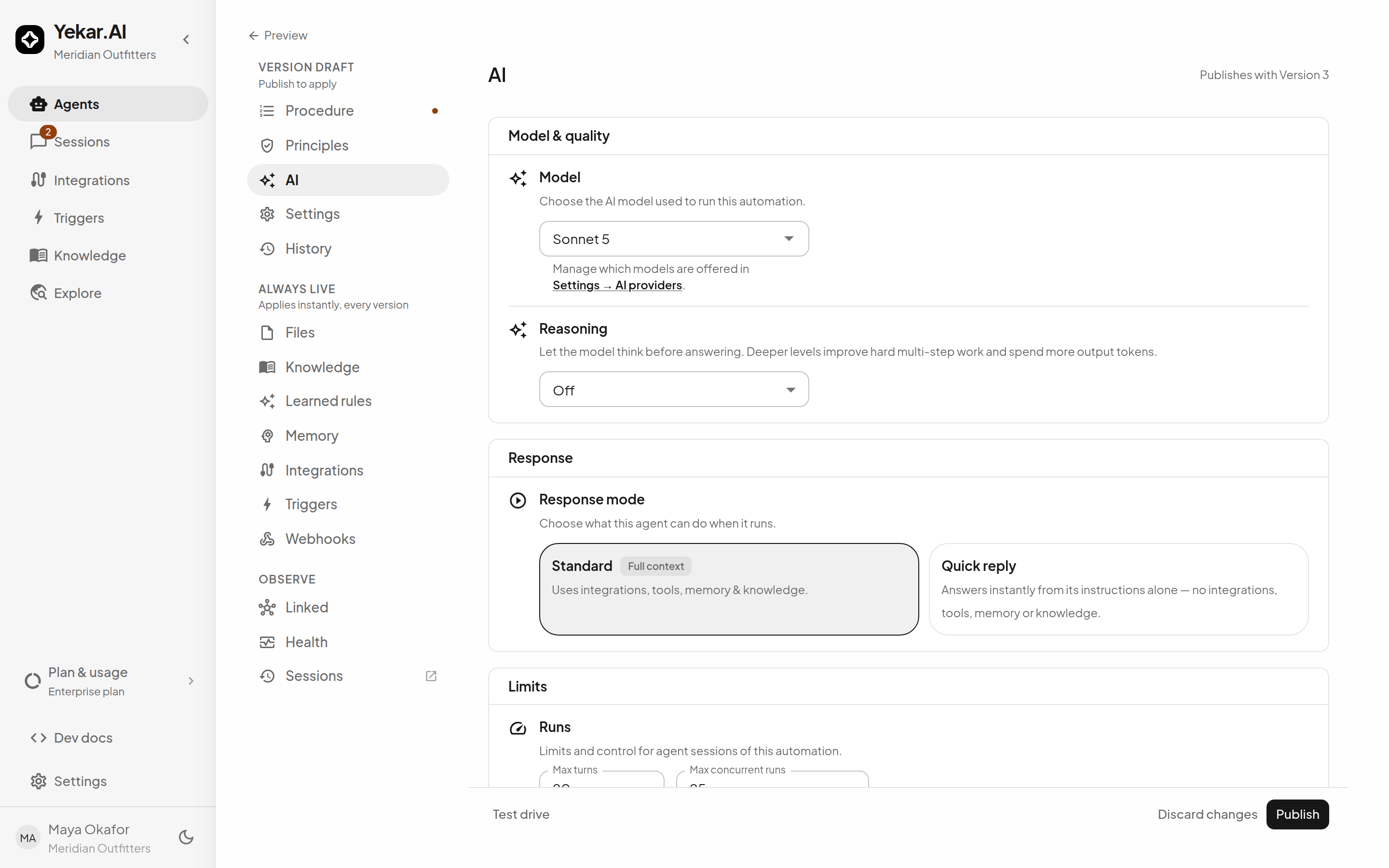
Every agent runs on one model, chosen in Setup → AI → Model or left to the organization's default. The picker offers only what the organization has turned on, so the list an author sees is the first place a provider being off shows up. AI providers is where that offering is set; this page is about choosing well within it.
Pin or default
An agent with no model pinned runs the organization's default: the preferred catalog model if its provider is configured, otherwise the most capable model of any configured provider. The picker always shows the model the next turn will actually execute - never a stale label - and a pinned model whose provider has since been turned off stays visible, flagged as unavailable, with the remedy beside it.
Pin a model when the agent's job depends on it. Leave the default for agents whose work is routine, so that a provider change is one change.
A rough guide
| Work | Choose |
|---|---|
| Routing, classification, short replies, high volume | A small fast model from the vendor you already pay |
| Judgement, multi-step tool use, long documents | A frontier model with a large context window |
| Reading images | A model with image input - the picker's hint says which; a model without it drops the image and says so |
| Deterministic flow steps with no model field | The default model |
Cost scales with tokens in and out, and a tool-heavy turn is several model rounds, each carrying the whole context again. A 1M-token window is room, not a target: Long conversations explains how a turn is trimmed to fit, and the organization can cap the window below the model's own.
Reasoning
Reasoning lets the model think before it answers. Four levels: Off answers directly and is the cost-safe default; Low, Medium and High buy a thinking budget that grows with each step, spent as output tokens. Each vendor implements it its own way - Anthropic's thinking budget, OpenAI's reasoning effort, Google's thinking budget - and a model whose vendor rejects the setting fails the turn with the vendor's own error rather than quietly ignoring it. Raise it for an agent whose mistakes are reasoning mistakes; leave it off for one whose mistakes are missing facts.
Context windows
Each catalog entry declares its window, from 8K to 1M tokens, and a per-call output ceiling derived from it. An organization-wide Context window setting caps every agent's turn below the model's own; a per-turn meter in each session shows how much of the window that turn used and what was trimmed to fit.
What it costs, honestly
Catalog prices are metadata for estimation, not a rate card: they change when vendors change them, and a model outside the catalog has no price rather than a price of zero. What you can trust is spend: Settings → Plan & usage → Cost shows managed calls as charged actuals and own-key calls as an estimate against your provider's invoice, per agent, so a model choice is something you check against evidence after a week rather than guess. See Cost & budgets.
What runs where the agent does not choose
Flow language-model steps without a selected model, conversation titles, summaries, and evaluations use the default model. The same provider availability rules apply, so turning a provider off affects these features too.